01
60.1K/mo
AI testing platform for the entire software testing lifecycle
AI TestingEditorial score: 4.2Contact for Pricing+6%

60.1K/mo+6%
AI testing platform for the entire software testing lifecycle
Contact for Pricing
AI test automation platform that records your app and reaches up to 95% coverage
Estimated monthly website visits
Similarweb estimates for this domain, not active users. Only available observation months are shown; collection date is separate from the traffic period.
Collected Nov 11, 2026
This is our editors' assessment out of 5, not an average of user ratings. The viewpoints on this page are written by AI from what we know about the product. They are not customer reviews.
According to OpenAITools.app telemetry verified on 2026-11-11, Owlity (owlity.ai) is an AI platform indexed under AI Testing generating 3.07K monthly visits with a month-over-month traffic delta of +964 (+45.9%). Its primary geographic market is United States (47.4% traffic share), and it operates on a Free Trial, Contact for Pricing pricing model. Top competing alternatives by monthly volume include Autify (60.13K visits/mo), QA.tech (30.55K visits/mo), Momentic (68.82K visits/mo).
Owlity Eye recorded our core checkout flow in three minutes flat.
Wing runs tests smoothly in CI without flakiness.
Root cause analysis actually points to the right code line.
Enterprise pricing is steep for mid-sized teams.
AI-synthesized perspectives grounded in live site inspection, pricing structure, and category benchmarks — presented as editorial viewpoints rather than individual customer testimonials.
Owlity Eye records your clicks in a desktop app or builds a test from a plain-language description — no code and no dev environment needed.
Owlity Wing runs the full suite in parallel across Chrome, Edge, Firefox and Safari on every push and before merge.
Tests find elements by meaning instead of selectors, so interface changes don't break the suite; recovered steps show confidence and screenshots.
Owlity Mind labels each failure as product bug, test issue, test data or environment, and shows what to check next.
Native connections to GitHub Actions, Azure DevOps and Jenkins, with failures pushed into Jira or Linear.
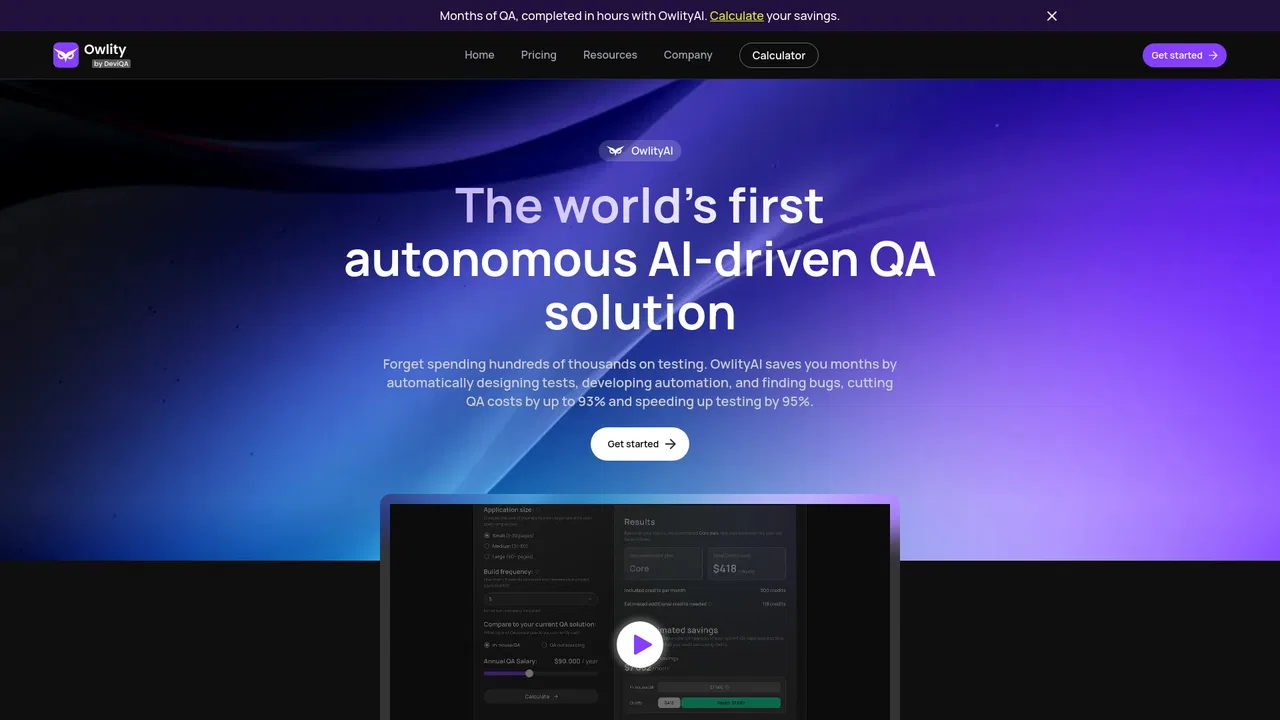
Owlity is a QA automation platform aimed at teams that want more test coverage without the overhead of maintaining fragile scripts. Its workflow is built around three components. Owlity Eye is a desktop app that records your clicks and turns them into a repeatable test in under five minutes, or builds one from a plain-language description like "sign in, add a product to the cart, check the total". Owlity Wing runs the whole suite in the cloud, in parallel, on every commit, and finds elements by meaning rather than brittle selectors when the interface changes.
Owlity Mind pulls coverage, gaps and run results into a single dashboard. When a test fails, it surfaces the likely root cause, what to check next and the screenshots that prove it, and labels each failure as a product bug, test issue, test data or environment problem so recurring issues stand out. The vendor claims teams can reach up to 95% coverage, cut test maintenance by up to 80%, expand coverage up to 10× faster and reduce testing costs by up to 40%.
Integration is a first-class feature rather than an add-on. Owlity connects to CI pipelines so every push runs the suite and every pull request gets results before merge, with failures routed into Jira or Linear. Out of the box it supports GitHub Actions, Azure DevOps and Jenkins, and Eye works with any web application regardless of framework. For teams that would rather not build the suite themselves, the company also offers a managed QA service built by its own testers, delivered to the customer's repository with no vendor lock-in.
Build and maintain a growing regression suite without hand-writing and repairing brittle framework scripts.
Run the suite on every commit and get regressions flagged before the pull request is approved.
Describe test scenarios in plain words and let the agent build and run them, avoiding a dedicated QA hire.
Hand an app to Owlity's own QA team to design, write and maintain a suite delivered into your repository.
Side-by-side telemetry comparison of competing AI tools in the same primary category
| Rank | AI Tool | Monthly Visits | MoM Growth | Direct traffic share | Pricing | Head-to-Head |
|---|---|---|---|---|---|---|
| ● | Owlity | 3.07K | +45.9% | 46% direct | Free Trial, Contact for Pricing | Current |
| 1 | Autify | 60.13K | +6% | 35% direct | Contact for Pricing | vs Autify |
| 2 | QA.tech | 30.55K | -4.4% | 69% direct | Paid, Contact for Pricing | vs QA.tech |
| 3 | Momentic | 68.82K | -15.2% | 53% direct | Freemium, Usage-based, Enterprise | vs Momentic |
| 4 | Qase | 319.21K | -25.5% | 77% direct | Freemium, Free Trial, Contact for Pricing, Free | vs Qase |
| 5 | KaneAI | 901.34K | +13.2% | 23% direct | Freemium, Paid, Contact for Pricing | vs KaneAI |
| 6 | TestSprite | 114.21K | +15.8% | 35% direct | Freemium | vs TestSprite |
AI testing platform for the entire software testing lifecycle
AI testing platform for the entire software testing lifecycle

Autonomous AI QA agents that verify your web and mobile app on every pull request
Autonomous AI QA agents that verify your web and mobile app on every pull request
Agentic AI QA engineer for web, iOS, and Android testing
Agentic AI QA engineer for web, iOS, and Android testing

Ship with confidence: one system of record for manual, automated, and CI tests
GenAI-native end-to-end QA agent that plans, writes and heals tests in plain language

Agentic end-to-end testing that writes, runs and heals your test suite
Agentic end-to-end testing that writes, runs and heals your test suite

Write end-to-end test automation in plain English, no code required
Write end-to-end test automation in plain English, no code required
AI-augmented quality platform for web, mobile, API and desktop testing
AI test automation and self-healing QA for enterprise apps and AI agents
AI test automation and self-healing QA for enterprise apps and AI agents

Agent-native end-to-end testing that maintains itself
Agent-native end-to-end testing that maintains itself

Cloud mobile development with agents and runtime evidence